
From Mars to Main Street: How OxEonEnergy Turned Space Technology into Clean Fuel Innovation
OxEon Energy's story began with an extraordinary challenge: producing oxygen on Mars. Long before the Utah company was developing clean fuel technologies for Earth, its founders helped create the solid oxide technology behind NASA's Mars Oxygen In-Situ Resource Utilization Experiment (MOXIE), which successfully generated oxygen from the carbon dioxide-rich Martian atmosphere. That breakthrough became the foundation for OxEon Energy, founded in 2017 to commercialize the technology for sustainable energy applications here on Earth.
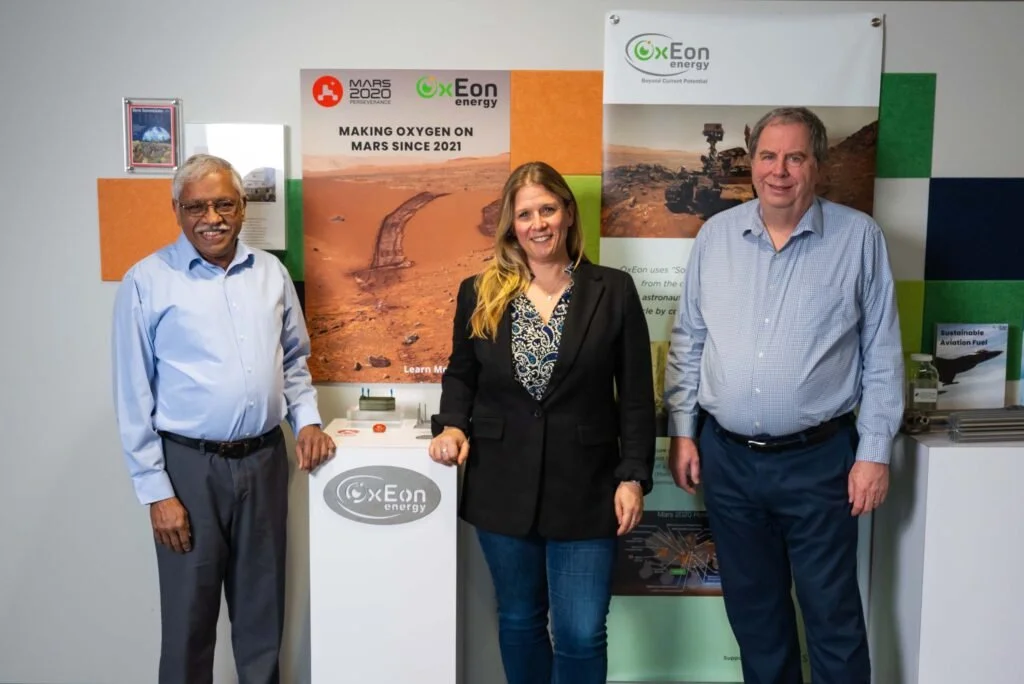
Today, OxEon develops advanced solid oxide systems that convert carbon dioxide, water, and methane into hydrogen, oxygen, synthesis gas, and sustainable transportation fuels. The company's technology supports applications in heavy industry, aviation, and space exploration by transforming waste carbon into valuable products. In Utah, OxEon recently demonstrated its technology at Wasatch Resource Recovery, where bio-carbon dioxide and bio-methane are converted into syncrude by combining three OxEon developed technologies. The syncrude can be refined into aviation fuel, diesel, and other clean fuels. A portion of the syncrude is already refined to make milspec JP fuel.
The company's success reflects decades of commitment to a single technology. Co-founder and Chief Scientific Officer Elango Elangovan has spent nearly 40 years advancing solid oxide systems, while the founding team has remained focused on solving the same core challenges instead of chasing new research trends.
"We never wavered in our focus," Elangovan said. "And it's not that we don't have interesting ideas, but we maintained our focus on solving this problem. It's built on our decades of experience."
That focus has translated into impressive success through the Small Business Innovation Research (SBIR) and Small Business Technology Transfer (STTR) programs. Since receiving its first award in 2018, OxEon has secured eight SBIR/STTR awards, including four Phase I and four Phase II awards from NASA, the U.S. Air Force, and the U.S. Department of Energy. OxEon recently received a Phase III award from NASA. The company has secured more than $7.2 million in SBIR/STTR funding for technology development and it recently received a $36.3 million Department of Energy award to expand its manufacturing capabilities.
According to Chief Operating Officer Jessica Elwell, that success comes from understanding agency priorities and building lasting relationships rather than simply pursuing every funding opportunity.
"I think some of that success rate is heavily dependent on relationship-building with the funding agency and really understanding what their goal is," Elwell said.
Elangovan has cultivated those relationships for decades, routinely meeting with agency project managers in person at the end of Phase I projects and providing updates throughout the project, even when they weren't required. Those conversations allowed him to explain the reasoning behind the team's approach, discuss results, and better understand agency needs. Over time, that strategy built trust and opened the door to future opportunities. In one case, NASA approached OxEon after a successful Phase II project with a new challenge, which ultimately led to a non-competitive Phase III award.
As OxEon has grown, Nucleus Grow has helped strengthen that trajectory through proposal reviews, networking opportunities, and bridge funding between Phase I and Phase II awards from the Utah Technology Innovation Funding (UTIF).
“We received a nonrecourse loan to help us go from Phase I to Phase II on two projects, and that funding helped bridge the time lapse between phases. That was a huge benefit and something that I hope the state continues to provide to innovative companies,” Elwell said.
Elwell also praised the proposal review process for helping the company communicate highly technical concepts more clearly to reviewers. At the same time, Elangovan noted that timely feedback often improved the organization and clarity of proposals without changing the underlying science.
The company has also benefited from Utah's collaborative innovation ecosystem, working with organizations including the University of Utah, World Trade Center Utah, 47G, the Utah Manufacturers Association, EDC Utah, Women Tech Council and local Small Business Development Center (SBDC). Elwell encourages emerging companies to take advantage of the state's many resources, noting that many businesses overlook valuable support simply because they don't know it exists.
For entrepreneurs entering the SBIR program, OxEon's advice is simple: stay focused on your core expertise, build relationships with funding agencies, and leverage the resources available to you. Nearly three decades after beginning work on solid oxide technology, the company's journey from producing oxygen on Mars to developing sustainable fuels on Earth demonstrates what can happen when long-term vision is paired with strategic partnerships and persistent innovation.
If your Utah small business intends to apply or you have questions about these funding opportunities, please contact Nucleus Grow at grow@nucleusutah.org.